
Leh Palace
A nine storey 17th century royal palace on Tsemo Hill overlooking Leh, the former seat of the Namgyal kings of Ladakh, now partly in ruins and partly a museum, and still the most recognisable building on the Leh skyline
- Palace & History
- ~3,500 m
- Centre of Leh town
- Apr to Oct
- Ladakh
What makes it special
You do not need a map to find Leh Palace. It is right there, visible from the moment you step outside your hotel. A dun coloured nine storey block sitting on the ridge of Tsemo Hill, directly above the old town, watching over the rooftops the way it has watched over them for close to four hundred years.
The palace was built around 1630 during the reign of King Sengge Namgyal, the most ambitious of the Namgyal dynasty rulers. He is the one who also built Hemis and Hanle monasteries, and the palace at Shey. According to local oral tradition, the site on Tsemo Hill was chosen by his predecessor Jamyang Namgyal, and the main designer was a Balti Muslim craftsman named Chandan Ali Singge, also known as Shinkan Chandan. The entire structure was completed in roughly three years, using locally sourced stone, sun dried mud bricks, and timber from poplar, juniper, and willow trees brought in from surrounding villages.
The architecture follows the same idiom as the Potala Palace in Lhasa, Tibet, and predates the Potala's current incarnation. Nine storeys climbing the contour of the hillside. The royal family lived on the upper floors, with the lower levels given over to stables, storerooms, and service quarters. The walls taper gently inward as they rise, and horizontal timber beams laced through the masonry prevent vertical cracks, a technique that has kept the basic structure standing through centuries of earthquakes, wars, and neglect. The windows grow from narrow slits near the base to full carved balconies on the upper floors, called rabsal, the number of which traditionally indicated a family's status. The entrance on the west side is a ceremonial porch with three carved lions, a nod to Sengge Namgyal's name (sengge means lion).
Here is the honest framing. The palace is in ruins. Not romantic, photogenic ruins, but genuine structural decay. After the Dogra invasion of the 1830s, the Namgyal royal family was forced to move across the Indus to Stok Palace, and the building was abandoned. For over a century and a half, weather, conflict, and neglect did their work. The Archaeological Survey of India declared it a Monument of National Importance in 1982 and began phased conservation, which has stabilised the structure but not restored it to anything close to its original condition. Most of the interior decorations, the murals, the painted woodwork, are gone or barely visible. The rooms you walk through are largely empty, with low ceilings that will force you to duck if you are tall. If you are expecting a grand palace interior, adjust that before you climb.
What you actually get, and it is genuinely worth the visit, is the rooftop. From the highest accessible terrace you can see the entire town of Leh laid out below, the Indus Valley stretching south toward Shey and Thiksey, the Stok range across the river, and the barren brown ridges of the Ladakh range fading into distance. On a clear late afternoon, when the light turns warm and the wind drops, this is one of the best viewpoints in all of Ladakh. No monastery or stupa gives you this exact combination of town, valley, and mountain in a single frame.
Inside, a small museum maintained by the ASI displays thangka paintings, some reportedly over 450 years old, along with royal jewellery, ceremonial dresses, crowns, old utensils, and artefacts from the Namgyal court. An audio visual room shows photographs and a short documentary on the palace's history. The content is modest but informative, and if you slow down and actually read the panels, you leave understanding more about the Namgyal dynasty than most travel guides tell you.
At the base of the palace complex sit several structures worth a pause. The Namgyal Stupa, built in honour of the dynasty's victories. The Chandazik Gompa, a small monastery with colourful murals of Avalokiteshvara. And the Chamba Lhakhang, a temple dating to approximately 1430, with medieval mural fragments visible between the inner and outer walls. None of these are guaranteed to be open on any given day, but when they are, they add real depth to the visit.
The Dosmoche festival, one of the last major Buddhist festivals of the year, is celebrated at Leh Palace grounds around February. Monks perform masked dances and rituals, and it is one of those events where the palace comes alive in a way the regular tourist visit simply cannot replicate. On certain nights of the year, the palace is also illuminated, most notably during the Galdan Namchot festival celebrating the birth of Tsongkhapa, when the whole building glows against the dark hillside.
Most travellers spend about an hour here. Walk up through the old town lanes, enter on the fourth floor (access below is restricted), climb through the low ceilinged rooms, reach the rooftop, sit with the view, walk back down. If you explore the museum, the base structures, and take your time, you might stretch it to ninety minutes. That is the right amount. This is not a destination you build a day around. It is a stop within your Leh days, ideally done on day one or two while you are acclimatising and staying close to town.
Quick answers
- Is Leh Palace worth visiting?
- Yes, as a one to two hour stop within Leh town. Most of the interior is in ruins and the rooms are empty. What you get instead is the rooftop view, the best panoramic viewpoint in Leh: the town below, the Indus Valley toward Shey and Thiksey, and the Stok range across the river. Add the walk through old Leh, the small museum, and the base structures, and it earns its hour. Go in late afternoon for the best light.
- What are the timings and entry fee for Leh Palace?
- Generally open daily from around 7 AM to 4 or 5 PM, though the ASI lists sunrise to sunset. Entry fees have varied across sources, with Indian visitors charged roughly Rs 15 to 50 and foreign nationals Rs 100 to 300. Cash only. Fees and timings are semi stable, confirm on arrival.
- How much time do you need at Leh Palace?
- One hour is comfortable. That covers the climb through the old town, the rooms, the rooftop, and the walk back. Add thirty minutes for the museum and base structures. Plan it as a late afternoon stop on day one or two of your Leh stay, when you are acclimatising and staying close to town.
Quick facts
Everything you need to know at a glance.
At a glance
- Altitude
- Roughly 3,500 m / 11,500 ft. Same elevation as Leh town.
- Location
- Tsemo Hill, directly above Leh old town and the main market. Visible from almost anywhere in Leh.
- Built
- Around 1630 AD by King Sengge Namgyal. Some sources say foundation laid from 1553 by Tsewang Namgyal.
- Nearest base
- Leh town itself. About 1 km from the main market, 4.5 km from the airport.
- Open season
- Open year round. Main tourist season roughly April to October.
- Visiting timings
- Generally 7 AM to 4 or 5 PM. Some sources cite sunrise to sunset. Confirm on arrival.
- Entry fee
- Nominal fee, historically Rs 15 to 50 for Indian visitors, Rs 100 to 300 for foreign nationals. Cash only. Confirm at the gate.
- Time needed
- 1 to 1.5 hours for most visitors.
- Difficulty
- Moderate. Steep lanes and stone steps from the market. Low ceilings inside. The altitude makes it harder than it looks.
On the ground
- Mobile network
- Good. Jio, Airtel, and BSNL all work in Leh town.
- ATMs
- Several in Leh main market, about 1 km from the palace base.
- Food
- Nothing at the palace. Leh main market is a 10 to 15 minute walk downhill with restaurants and cafes.
- Parking
- Small parking area near the entrance via a narrow road. Walking up from the market is easier and more interesting.
- Washrooms
- Basic near the palace. Cleaner options in the Leh main market below.
- Photography
- Allowed throughout the palace, courtyards, and rooftop. Museum photography may be restricted. Ask before shooting inside shrines.
- Drones
- Strongly discouraged. Leh is a military area with active air traffic.
Seasonal weather
- Apr to May18°2°Spring (Apr to May)
- Jun to Aug28°10°Summer (Jun to Aug)
- Sep to Oct18°0°Autumn (Sep to Oct)
- Nov to Mar5°-15°Winter (Nov to Mar)
Suitable for
- Couples — suitable
- Families — suitable
- Seniors — with some care
- Solo — suitable
- First-timers — suitable
- Pet-friendly — not suitable
How to reach Leh Palace
4 approach routes, with seasonal access.
From Leh Main Market (walking)
Year round- Distance
- About 1 km
- Time
- 15 to 20 minutes uphill
- Road
- Narrow old town lanes, stone steps, steep in places
The best way to reach the palace. Walk up from the main market through the old town of Leh, past traditional Ladakhi houses with flat mud roofs, small shops, and narrow stone lanes. The old town itself is the warm up to the palace visit, and skipping it by driving means missing half the experience.
From Leh Airport
Year round, flights mainly April to October with limited winter service- Distance
- About 4.5 km
- Time
- 15 to 20 minutes by taxi
- Road
- Tarred road to Leh, then narrow lanes to the palace
Take a prepaid taxi to your hotel in Leh and visit the palace after resting. Do not climb to the palace on arrival day. Visit on day two at the earliest.
From Manali via Leh Manali Highway
Generally late May or June to mid October- Distance
- Roughly 475 km to Leh
- Time
- 2 days by road
- Road
- High altitude highway with passes above 4,000 m
The overland route crosses multiple high passes. Most travellers take two days with an overnight at Jispa, Keylong, or Sarchu. Once in Leh, the palace is right in town.
From Srinagar via Zoji La
Generally April or May to November- Distance
- Roughly 420 km to Leh
- Time
- 2 days by road
- Road
- NH 1, mountain highway
Through Drass and Kargil with a night halt at Kargil. Once in Leh, the palace is a 15 minute walk from the centre.
Best time to visit
Season by season, so you can plan around the weather rather than hope.
- Recommended
Spring
April to May
The valley greens up, apricot blossoms appear, and the palace is quiet.
- Temperature
- Roughly 10 to 18°C day, minus 2 to 5°C night
- Crowds
- Low to moderate
- Light
- Clean and sharp, best for photography
- Access
- Flights resume mid April, roads open gradually
One of the better windows for a first visit. The air is crisp, daytime highs are comfortable, and morning light on the palace walls is clean and sharp. Apricot and almond trees blossom along the lanes of old Leh in late April and early May. Crowds are lighter than summer and you can often have the rooftop to yourself on a weekday morning.
Summer
June to August
Warmest days, peak tourist traffic. Go early or late to avoid the heat and the crowds.
- Temperature
- Roughly 18 to 28°C day, 8 to 12°C night
- Crowds
- High, peak in July and August
- Sun
- Intense. Carry sunscreen for the rooftop
- Best time of day
- Before 9 AM or after 4 PM
Peak tourist season. Temperatures can touch the high twenties, the sun is intense at altitude, and the rooftop can feel uncomfortably hot between 11 AM and 3 PM. Go early morning or late afternoon. The Ladakh Festival in September adds cultural events around Leh.
- Recommended
Autumn
September to October
Golden poplars, sharp light, thinning crowds. Quietly the best season for the view.
- Temperature
- Roughly 8 to 18°C day, minus 3 to 5°C night
- Crowds
- Dropping through the season
- Photography
- The best window of the year
- Festival
- Ladakh Festival usually in September
The skies are their clearest, the poplars along old town lanes turn gold, and the Stok range is razor sharp against blue sky. This is the light photographers wait for. Tourist numbers drop after early September and by October you can have the rooftop nearly to yourself.
Winter
November to March
Cold, quiet, the palace stays open but services shut down. Dosmoche is the exception.
- Temperature
- Minus 5 to 5°C day, minus 15 to minus 25°C night
- Crowds
- Almost none
- Access
- Flights only, with cancellations common
- Festival
- Dosmoche around February
The palace stays open and the ASI keeps it accessible, but Leh itself shuts down. Temperatures drop to minus 15 or lower at night, most hotels close, and flights are the only way in. The Dosmoche festival around February transforms the palace grounds with masked dances and rituals. For travellers already in Leh on a winter trip, not a reason to plan one.
Things to see & do
6 things worth your time at Leh Palace.
Climb through the old town lanes to the palace
15 to 20 minutesStart from the main market and walk uphill through the narrow lanes of Leh old town. This is the part most people rush through, and they should not. The old town is one of the last surviving medieval urban settlements in Ladakh, with traditional flat roofed houses of mud brick and timber, small shrines tucked into corners, and wooden balconies that lean over lanes barely wide enough for two people. The path climbs past the mosque in the lower market area, up through residential lanes where laundry hangs between houses and someone is always hauling firewood. By the time you reach the palace entrance, you have earned the view. Do not drive up and miss this.
Stand on the rooftop and let the view settle
15 to 30 minutesThe rooftop terrace is the single best reason to visit. From here you see Leh town spread out directly below, the Indus Valley stretching south toward Shey, Thiksey Monastery visible on its hillock, and the snow capped Stok range filling the southern sky. Look west and you can pick out Shanti Stupa on its hilltop across the valley. On a clear afternoon, the depth of view is startling. Most people glance, take a photo, and leave. Sit on the low wall for ten or fifteen minutes instead. Watch the shadows move. The view changes faster than you expect as the light shifts, and the hour before sunset is when the Stok range turns gold.
Walk through the museum and audio visual room
20 to 30 minutesThe ASI maintained museum is modest but honest. Thangka paintings, some reportedly over 450 years old, with colours derived from crushed gems and powdered stone that have survived remarkably well. Royal jewellery, ceremonial dresses, crowns from the Namgyal court, and old utensils. An audio visual room plays a short documentary with photographs and historical context. Most visitors skip through in five minutes. Give it twenty.
Visit the Chandazik Gompa and Chamba Lhakhang at the base
15 to 20 minutesThese structures at the base of the palace complex are often locked, but when they are open, they add real historical depth. The Chandazik Gompa has murals of Avalokiteshvara, colourful and intact in a way that the palace interiors are not. The Chamba Lhakhang dates to roughly 1430, with medieval mural fragments between the inner and outer walls that predate the palace itself by two centuries. The Namgyal Stupa at the base is freely accessible.
Catch sunset from the palace or the lanes below
30 to 45 minutesLate afternoon is when the palace visit works best. The sun drops behind the western ridges and the light on the Stok range turns from white to gold to pink in the space of twenty minutes. If the palace is still open, the rooftop is the spot. If the gate has closed, walk up to the Namgyal Tsemo hilltop above the palace for an even higher vantage, or sit in the lanes of old Leh as the shadows stretch across the mud brick walls.
Walk up to Namgyal Tsemo above the palace
30 to 45 minutes round trip from the palaceAbove and behind the palace, on the very top of Tsemo Hill, sits the Namgyal Tsemo Gompa and a ruined fort. A steep path from behind the palace climbs to the top. The monastery has a three storey gold painted Maitreya Buddha and old murals. The fort is mostly in ruins but the view is even wider than the palace rooftop, and you can see the full sweep of the Indus Valley in both directions. According to local tradition, a secret passage once connected the palace to this hilltop, used by the royal family as an escape route during attacks. Go in the morning or late afternoon when the light is good.
Know before you visit Leh Palace
The practical bits, from people who have been.
What Leh Palace actually is, and what it is notA ruin with an outstanding rooftop view, not a restored palace interior.
What it is. A nine storey 17th century royal palace, now partly in ruins, partly a museum, and entirely a viewpoint. The architecture is impressive from the outside. The rooftop view is outstanding. The museum is modest but informative. The old town walk up to it is half the experience.
What it is not. A grand, restored palace with furnished rooms, guided tours, and polished exhibits. If you have been to the City Palace in Udaipur or even to Stok Palace across the Indus, adjust your expectations. Most rooms are empty. Ceilings are low, some barely five feet. The murals that once covered the walls are mostly gone. The grandeur is in the structure from the outside and the view from the top, not in what you find inside.
Why go then. Because the rooftop gives you the single best panoramic view in Leh. Because walking up through the old town is a genuine cultural experience. Because the palace's position on the skyline, the way it dominates the entire town, tells you something about the Namgyal kings that no textbook captures. And because on a quiet late afternoon, sitting on the rooftop with the Stok range turning gold, the palace earns its place in your trip.
Who it suits and who should know what to expectGreat for history and views. Less so for those expecting a restored palace.
Works well for. History and architecture enthusiasts who appreciate context over polish. Photographers chasing the Leh rooftop panorama, especially at golden hour. First time Leh visitors on their acclimatisation day who want a gentle, close to town stop. Couples who enjoy the old town walk together. Anyone who wants to understand the Namgyal dynasty story across Leh Palace, Shey, and Stok.
Might feel underwhelmed. Travellers who expect a rich palace interior. The rooms are empty and the ceilings are low. If your benchmark is Rajasthan's restored palaces, Leh Palace is a very different experience. Also, midday in summer can be uncomfortably hot on the rooftop, and the climb at 3,500 metres is harder than it looks.
Families with kids. Older kids who can manage a 15 to 20 minute uphill walk will find the rooftop view exciting. Very small children and the low ceilings do not mix well. The old town walk with its animals and shops is more engaging for them.
Senior travellers. The climb through old Leh is steep and uneven. At 3,500 metres, the thin air makes every step harder. Healthy, acclimatised seniors with good knees manage it at a slow pace. A motorable road allows driving closer to the entrance for those who cannot walk up. Anyone with heart, lung, or blood pressure concerns should consult a doctor.
Pets. Not practical inside the palace complex.
When and how to time your visitLate afternoon for the light. Day one or two of your Leh stay. Pair with Namgyal Tsemo.
Best time of day. Late afternoon, between 4 and 5:30 PM, for warm golden light on the rooftop and sunset on the Stok range. Early morning between 7 and 9 AM is the quietest window. Midday between 11 AM and 2 PM is when the sun is harshest and tour groups fill the narrow rooms.
How to fit it in. Most first time Leh visitors do the palace on day one or two, while acclimatising. It works well as a late afternoon stop after resting in the morning. Walk up from the main market, spend an hour, and walk back down for dinner. Day three onward is typically when you head out to the Indus valley monasteries or up to Khardung La and Nubra.
Combining with Namgyal Tsemo. The gompa and ruined fort directly above the palace add 30 to 45 minutes if you want a higher viewpoint. Some travellers do both in a single late afternoon, palace first then Tsemo for sunset.
The Dosmoche angle. If you are in Leh in winter (around February), the Dosmoche festival at the palace grounds transforms the whole place. Masked dances, rituals, local gatherings. The palace in festival mode is a completely different experience.
Altitude and practical notesDo not visit on arrival day. Carry water. Confirm timings locally.
Leh Palace sits at the same altitude as Leh town, roughly 3,500 metres. If you have flown in, do not climb the palace on your arrival day. Spend the first day resting, drinking water, and walking gently in the main market area. The palace climb on day two is usually fine for most people.
The walk up involves steep lanes and uneven stone steps. Carry water. Wear shoes with grip. The sun at this altitude is stronger than it feels, so sunscreen and a hat are worth having, especially on the rooftop.
There are no medical facilities at the palace. The nearest hospital is SNM Hospital in Leh, about 2 km away. Carry your own basic kit.
The palace is an ASI protected monument. Do not touch or lean against old walls, murals, or wooden structures. Even gentle contact accelerates decay. Carry your litter out. There are no bins inside.
Timings, entry fees, and access rules can change with the season. Confirm locally before visiting, especially outside the main April to October window.
What I would tell a friend before they goWalk up, go late afternoon, pair with Namgyal Tsemo for the full experience.
Walk up from the market. Do not drive. The old town is half the experience.
Go late afternoon. The rooftop in golden hour light, with the Stok range turning colour, is the version of Leh Palace that people remember.
Do not expect interiors. The value is the architecture from outside, the rooftop view, and the walk through old Leh.
If the Chandazik Gompa or Chamba Lhakhang at the base are open, go in. Their murals are in better shape than anything inside the palace.
Carry small cash for the entry fee. UPI may or may not work at the ticket window.
Pair it with Namgyal Tsemo above. Together, the palace and Tsemo make a solid two hour late afternoon.
If you are doing the Indus valley monasteries on another day, visit the palace first. Knowing that Leh Palace was the Namgyal dynasty's main court while Shey was their summer capital adds a thread that connects the whole trip.
Nearby attractions
Other places worth the detour.
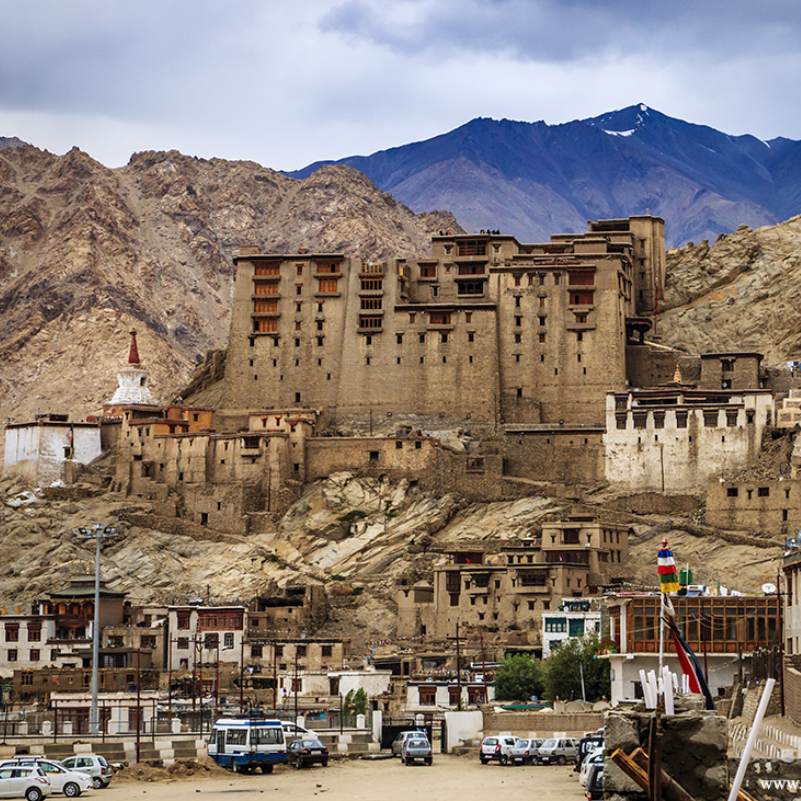
Namgyal Tsemo Gompa and Fort
300 metres above the palace, 15 to 20 minute climb
Directly above Leh Palace on the top of Tsemo Hill. A monastery with a three storey gold painted Maitreya Buddha, old murals, and the ruins of a fort built by King Tashi Namgyal in the 16th century. The view from the top is even wider than the palace rooftop. A natural extension of the palace visit.
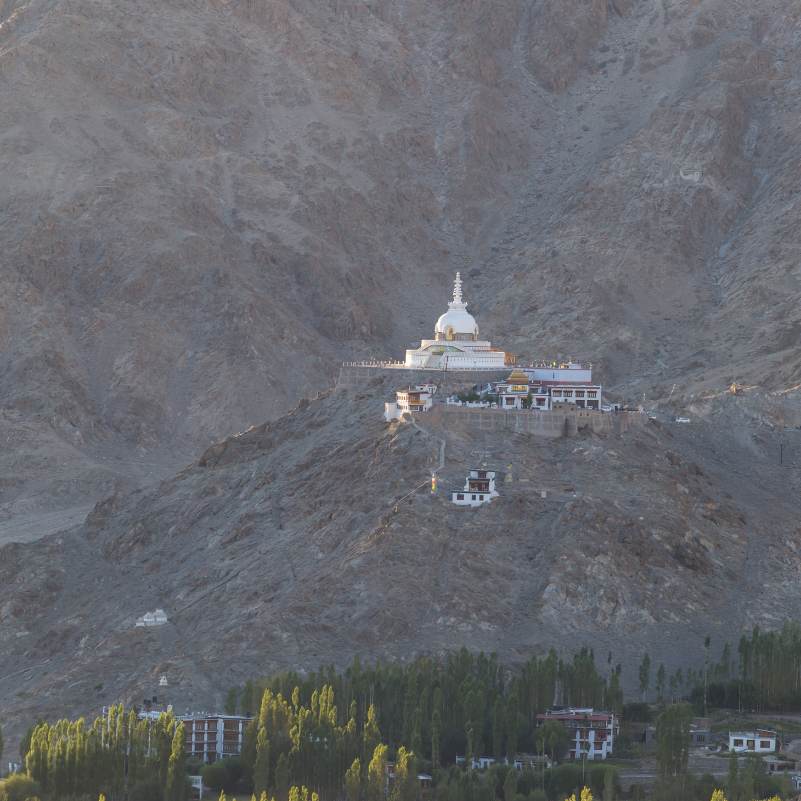
Shanti Stupa
About 3 km from the palace
A white domed Buddhist stupa on a hilltop west of Leh, built in 1991. The sunset view from Shanti Stupa, looking across to Leh Palace and the Stok range, is one of the classic Leh photographs. About 500 steps from the base, or accessible by road. Free entry.
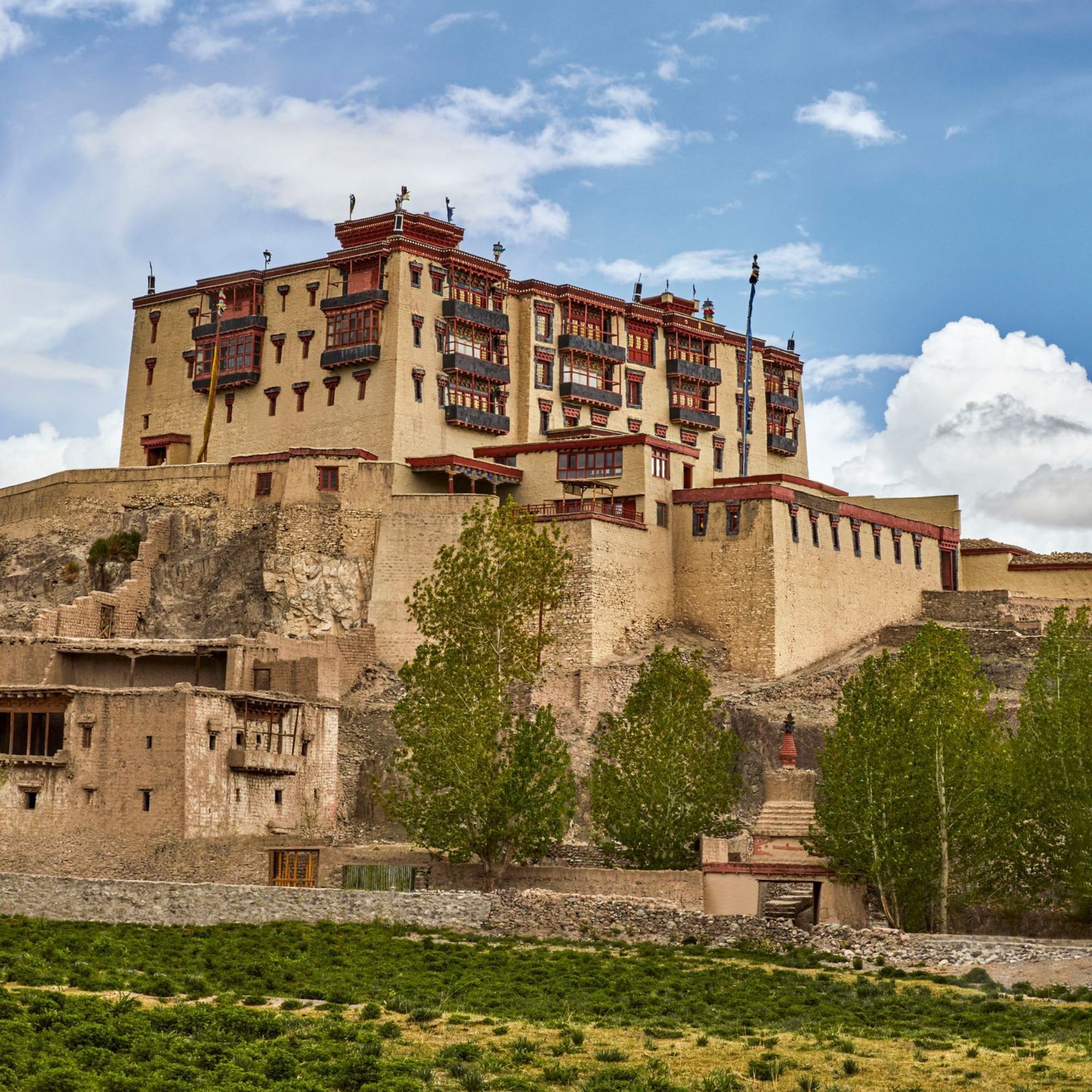
Stok Palace and Museum
About 15 km south, across the Indus
Where the Namgyal family moved after abandoning Leh Palace during the Dogra invasion. The palace museum has royal thangkas, jewellery, and ceremonial robes. A natural companion if you are interested in the Namgyal story.
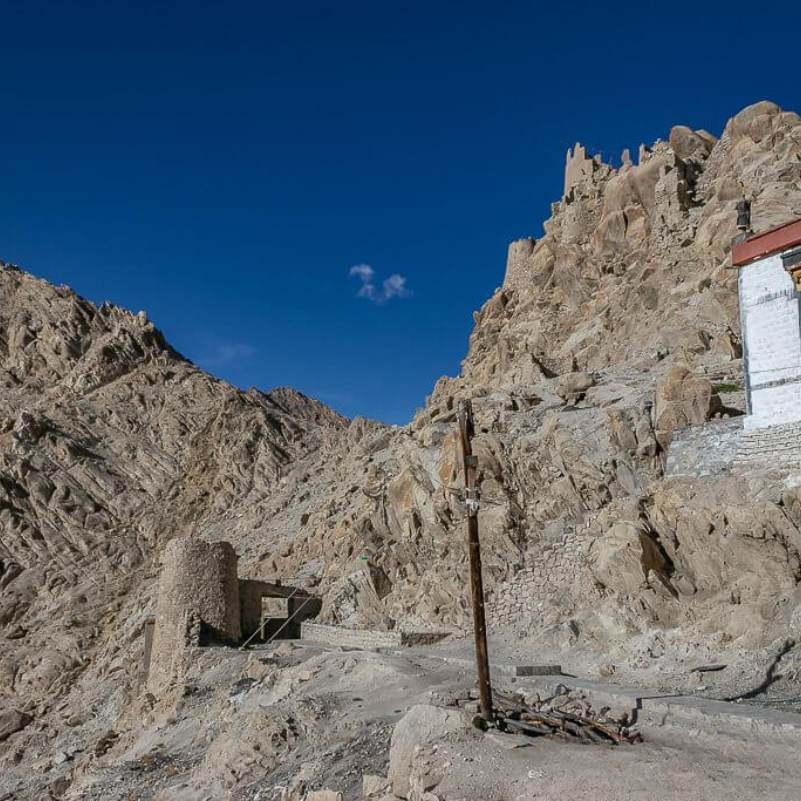
Shey Palace and Monastery
About 15 km south on the Leh Manali highway
The former summer capital of the Namgyal kings, with a 12 metre Shakyamuni Buddha cast in 1655. A 45 to 60 minute stop on the Indus valley monastery circuit from Leh.
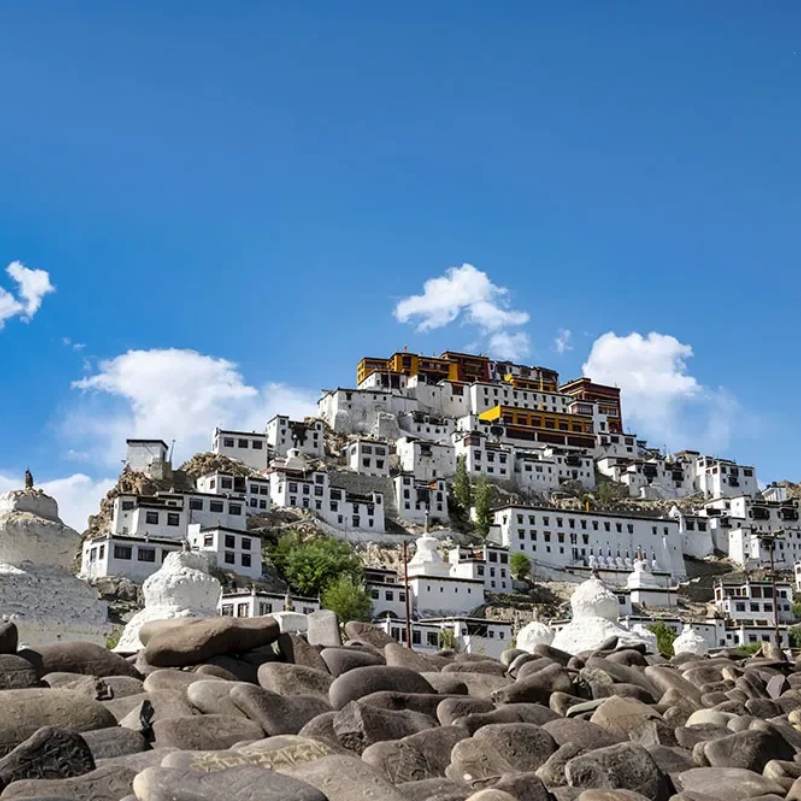
Thiksey Monastery
About 19 km south on the Leh Manali highway
A 12 storey Gelugpa monastery with a 15 metre Maitreya Buddha and one of the best morning prayer sessions in Ladakh. The standard monastery day from Leh covers Shey, Thiksey, and Hemis.
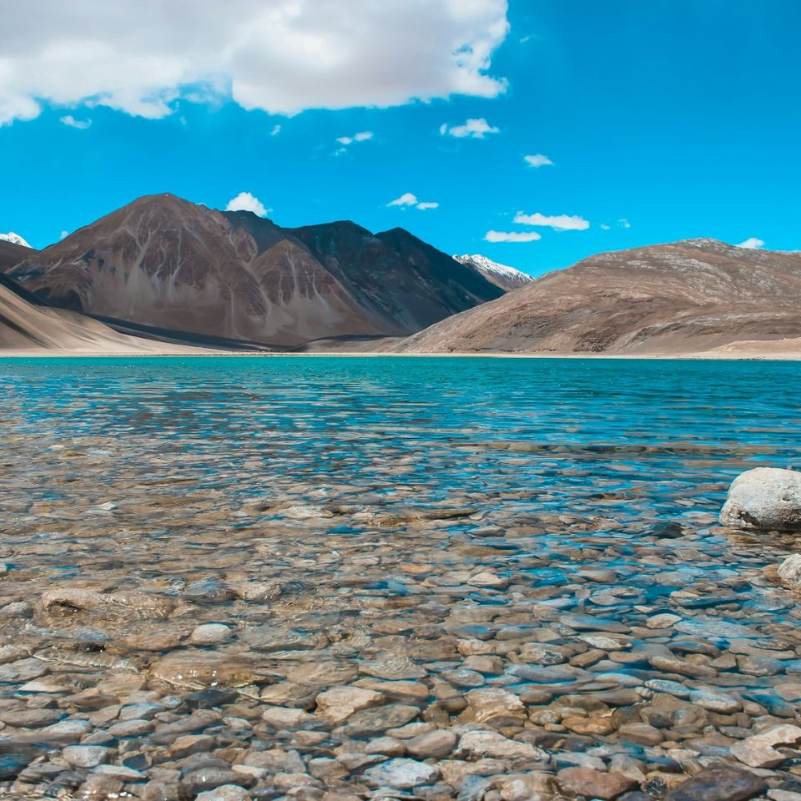
Pangong Lake
About 160 km east via Chang La
The high altitude lake on the India China border. A separate overnight trip from Leh requiring a permit. Most itineraries include Pangong as a two day leg.
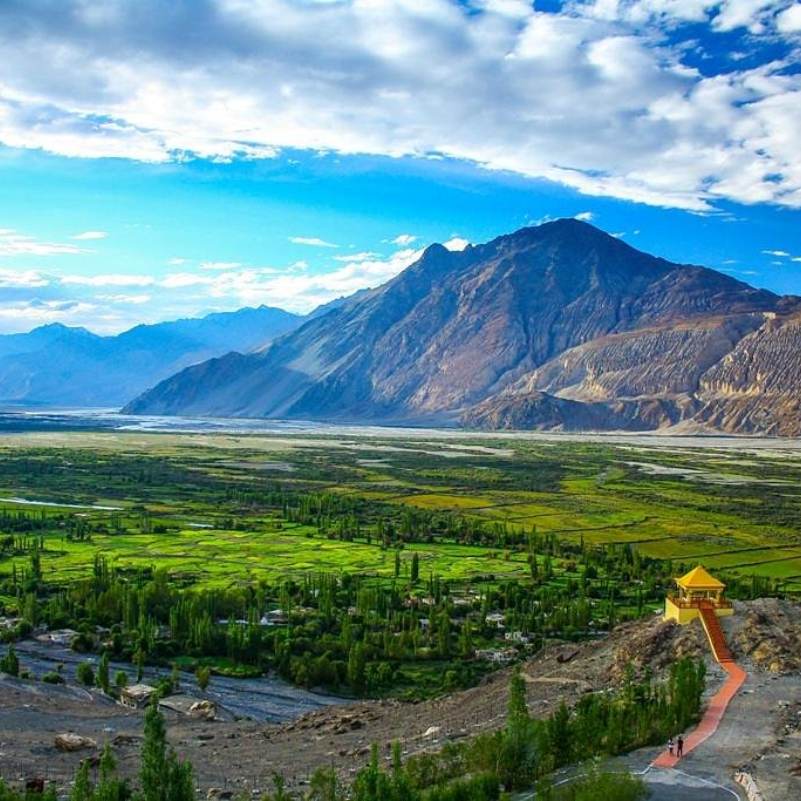
Nubra Valley
About 120 km north via Khardung La
The valley north of Leh, reached across Khardung La. Sand dunes at Hunder, Diskit Monastery, and the Balti village of Turtuk. A separate two to four night leg requiring a permit.
Our packages with Leh Palace
Curated trips that include a visit to Leh Palace.
 4D/3N
4D/3NLeh Ladakh Quick Escape
2D Leh•1D Pangong Lake
₹20,999₹24,999SAVE INR 4,000/ person Group Tour6D/5N
Leh Ladakh Group Tour With Nubra Valley and Pangong Lake
2D Leh•1D Nubra Valley+1
₹18,999/ person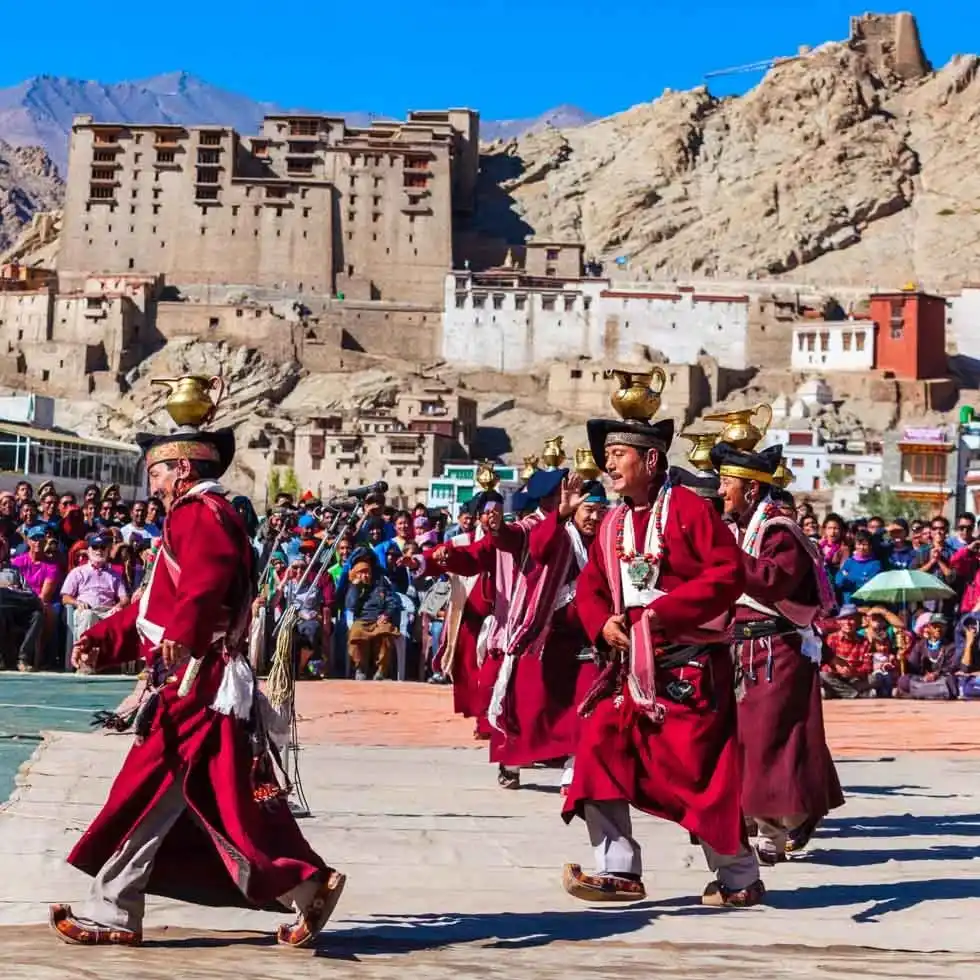 7D/6N
7D/6NLeh Ladakh Tour With Turtuk Village Nubra Valley and Pangong Lake
2D Leh•2D Nubra Valley+1
₹27,999₹33,999SAVE INR 6,000/ person
Common questions about Leh Palace
Where exactly is Leh Palace?
On Tsemo Hill, directly above the old town and main market of Leh. About 1 km from the main market and 4.5 km from Leh airport. Visible from almost anywhere in Leh town.
What is the altitude of Leh Palace?
Roughly 3,500 metres (about 11,500 feet), the same as Leh town. The rooftop adds a few more metres. No additional altitude concern beyond what you face in Leh.
Who built Leh Palace and when?
King Sengge Namgyal of the Namgyal dynasty built it around 1630 AD. Some sources say the foundation was laid earlier by Tsewang Namgyal from 1553. The main designer was reportedly a Balti craftsman named Chandan Ali. Completed in roughly three years.
Why is Leh Palace compared to the Potala Palace?
Both are large, multi storey royal buildings in the Tibetan architectural style. Leh Palace predates the current Potala (rebuilt from 1645). The tapering walls, horizontal timber beams, and stone and mud brick construction are similar. Leh Palace is considerably smaller.
Can I go inside Leh Palace?
Partly. You enter on the fourth floor (lower floors restricted). You can walk through several rooms, visit the small museum, and climb to the rooftop. Most rooms are empty and the interiors are largely ruined. The main experience is the architecture from outside and the rooftop view.
Is there a museum at Leh Palace?
Yes. A small ASI maintained museum displays thangka paintings (some reportedly over 450 years old), royal jewellery, ceremonial dresses, crowns, and utensils from the Namgyal court. An audio visual room shows a documentary with historical photographs.
Do I need a permit for Leh Palace?
No. The palace is in the centre of Leh town and requires no special permit. Just pay the entry fee with a valid photo ID. The Ladakh Environment and Development Fee (for Nubra, Pangong, Tso Moriri) does not apply to Leh Palace.
Is Leh Palace the same as Stok Palace?
No. Leh Palace was the main royal residence. Stok Palace, about 15 km south across the Indus, is where the royal family moved after the Dogra invasion of the 1830s. Visiting both gives you the full Namgyal dynasty story.
What is the Dosmoche festival at Leh Palace?
A Buddhist festival held at the Leh Palace grounds around February (dates follow the Tibetan lunar calendar). Monks perform masked dances and rituals. One of the few times the palace comes alive as a community gathering space.
How long should I spend at Leh Palace?
One hour for most visitors. Add thirty minutes for the museum and base structures. This is a stop, not a destination. Plan it as a late afternoon visit on day one or two of your Leh stay.
What should I combine Leh Palace with?
Namgyal Tsemo Gompa directly above. Shanti Stupa on the opposite hill for sunset. Leh main market for dinner. Together, the palace and Tsemo make a solid two hour late afternoon. Save the Indus valley monasteries for a separate day.
Is Leh Palace safe for solo women travellers?
Yes. The community is accustomed to tourists, the area is well trafficked during the day, and the walk through old Leh is on populated lanes. Standard precautions apply after dark.
Related guides
Posts about Ladakh
- Manali to Leh Highway 2026: Every Pass, Stop and Distance
- Umling La Ladakh Guide 2026: Route, Altitude, Permit, Safety & Reality Check
- Turtuk Ladakh Travel Guide 2026: Balti Culture, Apricot Orchards and Why It Is Perfect for Families
- Offbeat Ladakh for Couples in 2026: Quiet Routes Beyond Pangong and Nubra
- Aryan Valley Ladakh Guide 2026: Dah, Hanu, Brokpa Culture, Route and Who Should Visit
- Hanle vs Tso Moriri vs Turtuk: Which Offbeat Ladakh Place Should You Choose in 2026?