
Pahalgam
A valley town at 2,200 metres on the Lidder River, 90 km from Srinagar. The gentler half of a Kashmir trip: Betaab Valley, Aru Valley, Chandanwari, trout in the river, and the kind of mornings where sitting by the water counts as the plan.
- Altitude ~2,200 m / ~7,200 ft
- 90 km from Srinagar, 2.5 to 3 hrs
- Betaab, Aru, Chandanwari valleys
- Lidder River through the town
- Amarnath Yatra base camp
- Best season: Apr to Oct
What makes it special
Pahalgam is the quieter half of a Kashmir trip. If Gulmarg is about the gondola and the peak, and Srinagar is about the lake and the city, Pahalgam is about valleys, a river, and the kind of walking around that does not require a plan. The town sits at about 2,200 metres on the Lidder River in south Kashmir, about 90 km from Srinagar. The name means "Village of Shepherds," and even though tourism has replaced the shepherds, the pace still feels more village than resort. The Lidder runs right through town, fast and clear, and most visitors spend their first hour just sitting by it.
The main draws are three valleys that branch out from the town: Betaab Valley (named after the 1983 Bollywood film shot here), Aru Valley (the quieter, prettier one, and the base for serious treks), and Chandanwari (the starting point of the annual Amarnath Yatra). Most travellers call these the ABC valleys and cover them over one or two days using union taxis, since outside vehicles are not allowed on these routes. There is also Baisaran, a meadow above the town reachable by pony or a short walk.
Here is the ground reality. Pahalgam's sightseeing is controlled by a taxi union. Your Srinagar cab or private car cannot take you to Betaab, Aru, or Chandanwari. At the Pahalgam taxi stand, you hire a union vehicle at fixed rates. This can feel like a hassle, but it keeps the narrow valley roads manageable and the pricing is transparent once you know the system. Betaab Valley and Chandanwari are on the same road (east), and Aru is in the opposite direction (west), so the natural split is Betaab plus Chandanwari on one half day, and Aru on another.
The other thing most travel pages do not tell you clearly: Pahalgam itself, the town, is not the attraction. The attraction is the valleys around it and the Lidder River running through everything. The town market is small, the hotels range from budget to mid range (with a few genuine luxury properties), and there is not much to do in the town after dark. That is fine. You are here for the mornings, when the light hits the valley walls and the river sounds like the main character in the room.
Two nights is the sweet spot for most travellers. One full day covers Betaab Valley and Chandanwari. Another morning covers Aru Valley. The afternoons are for sitting by the Lidder, walking to Baisaran, or doing nothing in particular. One night works if you are pressed for time, but it means rushing the valleys. Three nights starts to feel long unless you are trekking.
If you are planning Pahalgam as part of a Kashmir trip, our Kashmir package covering Srinagar, Gulmarg, and Pahalgam handles the transport, stays, and union taxi logistics.
Quick answers
- Is Pahalgam worth visiting in 2026?
- Yes, especially if you like rivers, valleys, and a slower pace. Pahalgam is the gentler counterpart to Gulmarg. The Lidder River, Betaab Valley, and Aru Valley are the highlights. Two nights give you enough time to cover the main valleys without rushing. If you are combining it with Srinagar and Gulmarg on a Kashmir trip, Pahalgam adds a different texture: less touristy, more valley and forest, more sitting by a river than riding a gondola.
- What is the best time to visit Pahalgam?
- April to June for green valleys, comfortable weather, and clear mountain views. September and October for autumn colour, fewer crowds, and crisp air. Avoid July and August unless you are here for the Amarnath Yatra, because the town is crowded with pilgrims and monsoon rain makes the valleys wet and cloudy. Winter (December to February) brings snow but most tourist infrastructure scales down.
- How do I reach Pahalgam from Srinagar?
- About 90 to 95 km from Srinagar, 2.5 to 3 hours by road via Anantnag. The last stretch along the Lidder River valley is the scenic part. Taxis from Srinagar cost approximately Rs 3,000 to 4,500 one way. Shared vehicles are also available from Anantnag. Most Kashmir tour packages include the transfer.
Quick facts
Everything you need to know at a glance.
At a glance
- Altitude
- About 2,200 m / 7,200 ft. Lower than Gulmarg. No altitude concerns for most travellers. The sub valleys sit slightly higher, up to about 2,500 m.
- Location
- Anantnag district, south Kashmir. On the Lidder River, about 90 km southeast of Srinagar.
- Nearest base
- Srinagar, 90 km northwest. Anantnag, about 45 km, is the nearest major town on the highway.
- Best season
- April to June and September to October. July and August are crowded with Amarnath pilgrims. Winter brings snow but limited infrastructure.
- Timings
- No gate or timings for Pahalgam town. Betaab Valley opens at 8 AM. Union taxis start from early morning. Sub valley visits are best done in the first half of the day.
- Entry fee
- No fee for the town. Betaab Valley entry is Rs 100 per person. Aru has no entry fee. Chandanwari may have a small fee during yatra season. Union taxi charges are separate.
- Time needed
- Two nights and two full days is ideal. One night works for a compressed visit. Three nights if trekking or wanting slow days.
- Known for
- Betaab Valley, Aru Valley, Chandanwari (Amarnath Yatra start), the Lidder River, trout fishing, pony rides, and as a base for the Kolahoi Glacier and Tarsar Marsar treks.
- Difficulty
- Easy for the main valley visits (vehicle access plus short walks). Moderate for Baisaran and Aru meadow walks. Difficult for multi day treks like Kolahoi and Tarsar Marsar.
On the ground
- Mobile network
- Weak. Postpaid SIMs work in town with intermittent signal. Coverage drops significantly in the valleys. Download offline maps before you go.
- ATMs
- Available in Pahalgam town but can run out of cash in peak season. Bring enough from Srinagar. Union taxis, pony operators, and most small vendors are cash only.
- Food
- Restaurants in the main market serve Kashmiri dishes, basic Indian food, and Maggi. Hotel restaurants are the most reliable. Trout from the Lidder is the local speciality and worth trying.
- Parking
- Hotels have parking. Your Srinagar taxi parks at the hotel. Union taxis take over for sub valley sightseeing.
- Washrooms
- Available at hotels, Betaab Valley entrance, and some restaurants. Basic in the valleys. Plan ahead.
- Photography
- Strong throughout. The Lidder River, Betaab Valley meadow, and the Aru drive are the standout shots. Early morning light in the valleys is the best window.
- Drones
- Avoid. The area has military sensitivity due to proximity to the Line of Control and the Amarnath Yatra corridor.
- Safety
- Safe for tourists. The main risk is the Lidder River, which is fast and cold. Supervise children near the water. Standard precautions apply elsewhere.
Seasonal weather
- March to May20°5°Spring
- June to August28°12°Summer
- September to November22°3°Autumn
- December to February8°-5°Winter
Suitable for
- Couples — suitable
- Families — suitable
- Seniors — suitable
- Solo — suitable
- First-timers — suitable
- Pet-friendly — with some care
How to reach Pahalgam
3 approach routes, with seasonal access.
From Srinagar
Year round. The road is well surfaced. Winter driving is slower but the road stays open.- Distance
- About 90 to 95 km
- Time
- 2.5 to 3 hours by taxi
- Road
- Tarred highway via Anantnag, then a narrower but well surfaced valley road along the Lidder.
The standard approach. Leave Srinagar via Pampore (saffron fields if you are visiting in autumn) and Anantnag. The road follows the Lidder River for the last 45 km, and this stretch through pine forest is the scenic highlight. Stop at Anantnag for food or fuel if needed. Taxis from Srinagar cost approximately Rs 3,000 to 4,500 one way. Shared vehicles available from the TRC bus stand in Srinagar or from Anantnag.
From Srinagar Airport
Year round. Winter flights may face fog delays.- Distance
- About 95 km from the airport
- Time
- 3 to 3.5 hours by taxi including city traffic
- Road
- City roads to the highway, then the Anantnag to Pahalgam valley road.
Fly to Srinagar (about 1.5 hours from Delhi), then drive to Pahalgam. Most travellers spend a night or two in Srinagar first and drive to Pahalgam as the next stop on their Kashmir itinerary. Going directly from the airport to Pahalgam takes about 3 to 3.5 hours with city traffic.
From Gulmarg
Year round.- Distance
- About 140 km via Srinagar
- Time
- 4 to 5 hours total with a break in Srinagar
- Road
- Two separate highway drives via Srinagar.
Pahalgam and Gulmarg are on opposite sides of Srinagar. There is no direct road. You drive back to Srinagar (2.5 to 3 hours) and then on to Gulmarg (1.5 to 2 hours). Total about 4 to 5 hours of driving. Most Kashmir itineraries base in Srinagar and do Pahalgam and Gulmarg as separate excursions, which avoids the long drive.
Best time to visit
Season by season, so you can plan around the weather rather than hope.
- Recommended
Spring and early summer
April to June
Green valleys, snow on distant peaks, wildflowers, comfortable weather for walking
- Temperature
- ~5 to 25°C, cool mornings, warm afternoons by June
- Crowds
- Moderate. Rising through May and June.
- Highlights
- Green valleys, snow on peaks, wildflowers at Aru, pleasant walking weather
- What to carry
- Light jacket, sunscreen, comfortable walking shoes.
The valleys are at their greenest. Snow lingers on the higher peaks, creating the classic Kashmir combination of green meadows with white mountains behind. April and May are comfortable during the day. June gets warmer and busier. This is the best window for families and first time visitors. Betaab Valley is at its most photogenic. Aru is carpeted with wildflowers by late May.
Monsoon and yatra season
July to August
Amarnath Yatra crowds, monsoon rain, mist in the valleys, not the best window for sightseeing
- Temperature
- ~12 to 28°C, humid
- Crowds
- Very high during Amarnath Yatra. Hotels fill up.
- Rain
- Frequent and sometimes heavy
- Honest advice
- Come before or after unless you are on the yatra.
Monsoon rain makes the valleys wet and misty, and the Amarnath Yatra fills the town with pilgrims. Hotels are booked and prices spike. If you are doing the yatra, this is when you come. If you are visiting for the valleys and the river, avoid this window. Views are frequently blocked by cloud, trails get muddy, and the overall experience is below what Pahalgam delivers in other months.
- Recommended
Autumn
September to November
The best window: autumn colour, quiet valleys, clear mountain air, lowest crowds of the good season
- Temperature
- ~3 to 22°C, cold mornings by October
- Crowds
- Low
- Highlights
- Chinar colour, clear skies, quiet valleys, best photography light
- What to carry
- Warm layers. Proper jacket by October.
If you can choose one window for Pahalgam, this is it. September is warm during the day with thinning crowds. October brings chinar colour to the Lidder Valley, and the combination of gold and red trees, clear air, and low tourist density is as good as Pahalgam gets. November turns cold but is still manageable if you pack properly. The valleys are quiet, the light is clean, and hotels are cheaper.
Winter
December to February
Snow, quiet, reduced infrastructure, for travellers who like cold weather and solitude
- Temperature
- ~-5 to 8°C, cold days, freezing nights
- Crowds
- Very low
- Infrastructure
- Reduced. Some hotels and restaurants close.
- What to carry
- Heavy thermals, waterproof jacket, snow boots, gloves.
Pahalgam receives snow from December, and by January the valleys are white. The town is quieter, many hotels close or operate at reduced capacity, and the valleys are not always accessible by vehicle. If you want snow without the Gulmarg crowds and are comfortable with basic winter infrastructure, Pahalgam in winter has a particular charm. The Lidder continues to flow, the pine forests are dusted in white, and the silence is genuine. But pack for serious cold and expect limited dining and activity options.
Things to see & do
6 things worth your time at Pahalgam.
Betaab Valley
1 to 2 hoursThe most popular of the three valleys, and the one that gets the most photos. Named after the 1983 film shot here, the valley is a wide meadow with the Lidder River flowing through it, surrounded by pine covered mountains. Entry is Rs 100 per person. The first section near the bridge is where most tourists gather. Walk deeper into the valley for quieter spots. Best visited early morning (gate opens at 8 AM) before the midday crowd arrives. About 15 km from Pahalgam town, 20 to 30 minutes by union taxi.
Aru Valley
Half dayThe quieter, less commercialised valley, and many repeat visitors say it is the better one. A small village at about 2,400 metres surrounded by open meadows and mountain ridges, Aru is also the base camp for serious treks: the Kolahoi Glacier trek, the Tarsar Marsar lakes trek, and the route to Lidderwat. Even if you are not trekking, the 12 to 15 km drive from Pahalgam through pine forest along the west branch of the Lidder is one of the prettiest short drives in Kashmir. Pony rides available at Aru for exploring the upper meadows.
Chandanwari
1 to 2 hoursThe starting point of the annual Amarnath Yatra, 16 km from Pahalgam on the same road as Betaab Valley. Outside the pilgrimage season (July to August), Chandanwari is a quiet valley with the Lidder flowing through it and some snow patches lingering into early summer. Most travellers combine it with Betaab in a single half day trip. The road beyond Betaab continues to Chandanwari, so the union taxi can cover both in sequence.
Baisaran meadow walk or pony ride
1 to 2 hoursA pine covered meadow above Pahalgam town, reachable by a short walk or pony ride. Less dramatic than the main valleys but pleasant for an afternoon stroll. The views over the town and the Lidder Valley from the meadow are the draw. Ponies are available from the town for those who prefer to ride.
Trout fishing on the Lidder River
Half day or full dayThe Lidder River is stocked with brown trout, and Pahalgam has some of the best trout fishing in India. Fishing permits are required and can be obtained from the Fisheries Department in Srinagar or Pahalgam. The season runs roughly from April to September. Serious anglers rate the Lidder and its tributaries highly for catch and release fishing in clear mountain water.
Walk along the Lidder River
30 minutes to 2 hoursEven without a specific destination, walking along the Lidder through Pahalgam is one of the best things to do here. The river is fast, clear, and cold. Sit on the rocks, watch the light change on the valley walls, and let the sound do the work. Early mornings and late afternoons are the best windows. The stretch between the main market bridge and Mamaleshwara Temple is the most popular short walk.
Know before you visit Pahalgam
The practical bits, from people who have been.
The union taxi system: understand this before you arriveOutside vehicles are banned on valley roads. Hire union taxis at fixed rates from the Pahalgam taxi stand. Non negotiable.
This is the single most important thing to understand before arriving. Your Srinagar cab or private car cannot take you to Betaab Valley, Aru Valley, or Chandanwari. At the Pahalgam taxi stand, you hire a union vehicle at fixed, displayed rates. Forest department checkpoints on the valley roads enforce this.
The practical approach: arrive in Pahalgam, park your Srinagar cab at the hotel, walk to the taxi stand, and hire a union vehicle. Betaab plus Chandanwari is one trip (same road, east), roughly Rs 2,300 to 3,000 for an SUV. Aru Valley is a separate trip (opposite direction, west), roughly Rs 1,500 to 2,000. If you want all three in one day, budget 7 to 8 hours and about Rs 3,500 to 4,500 total. Rates can change with the season, so check the board at the taxi stand.
The system feels restrictive at first, but it keeps the narrow valley roads safe and the pricing transparent. Do not argue with the union or try to sneak your car through. The checkpoint will turn you back.
Which valleys to visit and how to prioritiseBetaab is the most popular. Aru is quieter and prettier. Chandanwari pairs with Betaab. Two days covers all three.
Betaab Valley. The most popular, the most photogenic on first glance, and the most crowded. Entry Rs 100. Best early morning. Good for families with young children because the access is easy and the main meadow area is flat.
Aru Valley. Quieter, more open, and with a genuine village feel. No entry fee. Base camp for the Kolahoi Glacier trek and the Tarsar Marsar trek. The 12 km drive from Pahalgam is prettier than the Betaab road. If you like hiking, spend longer here.
Chandanwari. Starting point of the Amarnath Yatra. Outside pilgrimage season, it is a quiet valley with snow patches in early summer. On the same road as Betaab, 16 km from town. Combine the two in a single half day trip.
If you have one day, do Betaab plus Chandanwari. If you have two days, add Aru on the second morning. If you are choosing just one valley and prefer quiet over crowds, choose Aru.
Practical tipsCarry cash, dress warm, arrive early at Betaab, respect the Lidder, and book ahead during yatra season.
Carry cash. ATMs exist in Pahalgam town but can run out in peak season. Union taxi operators, pony riders, and most small restaurants are cash only. Bring enough from Srinagar.
Carry warm layers. Even in summer, mornings and evenings are cool. The valleys are noticeably colder than the town. A light jacket in June. A proper warm layer by October.
Arrive early at Betaab. The gate opens at 8 AM. The crowd wave hits by 11 AM. Get there at 8:30 for the best experience.
Watch the river, respect the river. The Lidder is fast and cold. Do not wade beyond ankle depth. Do not let children play unsupervised near the water. Several accidents happen each year.
Book hotels ahead in July and August. The Amarnath Yatra fills Pahalgam with pilgrims, and hotels, especially budget ones, book out. If you are visiting for the valleys and not the yatra, come before or after this window.
Recheck locally. Union taxi rates, valley entry fees, and Amarnath Yatra dates can shift. Confirm details with your hotel or at the taxi stand when you arrive.
Nearby attractions
Other places worth the detour.
Dal Lake, Srinagar
About 90 km, 2.5 to 3 hours
The defining experience of Srinagar: shikara rides, houseboats, the floating vegetable market, and Mughal gardens. Most Kashmir itineraries start and end in Srinagar, with Pahalgam as an excursion. Two to three hours by road.
Gulmarg
About 140 km via Srinagar
Kashmir's ski resort and gondola destination, on the opposite side of Srinagar from Pahalgam. Most itineraries pair Gulmarg and Pahalgam as separate day trips or overnights from Srinagar. The two are about 140 km apart via Srinagar.
Martand Sun Temple
About 60 km from Pahalgam, near Mattan on the Srinagar road
An 8th century Hindu sun temple near Anantnag, on the road between Srinagar and Pahalgam. A short detour off the highway for anyone interested in Kashmiri archaeology. The carved stone structure is one of the most impressive pre medieval ruins in the valley.
Anantnag
About 45 km from Pahalgam
The last major gateway on the route to the Amarnath cave. During the yatra season (July to August), this is a massive transit point for pilgrims. Outside the season, it is a quiet valley town. On the road between Srinagar and Pahalgam.
Kolahoi Glacier
About 35 km trek from Aru
A glacier at the head of the Lidder Valley, reachable via a multi day trek from Aru. The trek passes through Lidderwat and is one of the most rewarding medium difficulty treks in Kashmir. For experienced trekkers.
Tarsar Marsar Lakes
Multi day trek from Aru
A pair of alpine lakes connected by a ridge crossing, reachable via a 4 to 5 day trek from Aru. One of the best regarded treks in Kashmir for the combination of lakes, meadows, and high ridges. Requires a guide and proper gear.
Our packages with Pahalgam
Curated trips that include a visit to Pahalgam.
 5D/4N
5D/4NBest Of Kashmir – Srinagar, Gulmarg & Pahalgam Tour Package
1D Srinagar•1D Gulmarg (day trip)+3
₹12,500₹28,999SAVE INR 16,499/ person 5D/4N
5D/4NKashmir Honeymoon Experience – Srinagar, Gulmarg & Pahalgam
1D Srinagar•1D Gulmarg (day trip)+3
₹14,999₹29,999SAVE INR 15,000/ person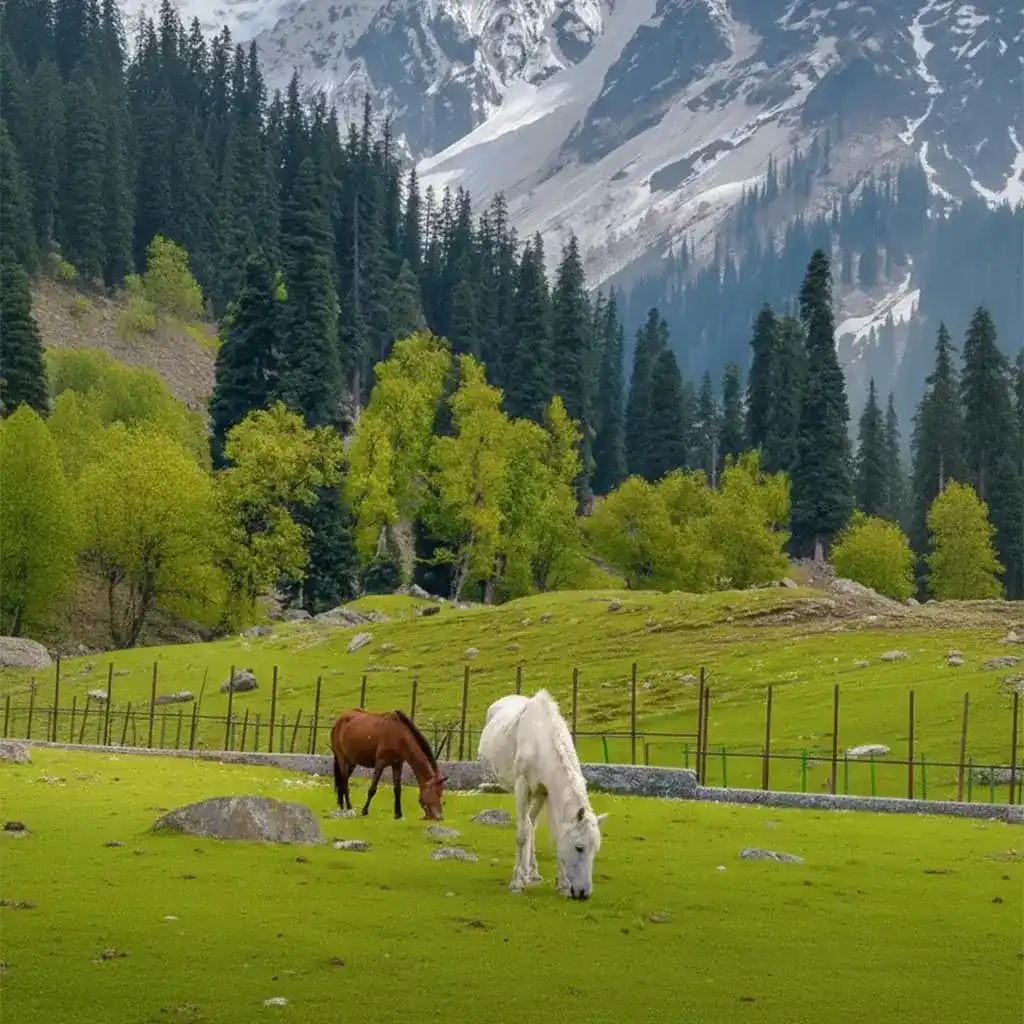 5D/4N
5D/4NTimeless Kashmir Retreat – Srinagar, Gulmarg & Pahalgam Experience
1D Srinagar •1D Gulmarg (day trip)+3
₹39,999₹65,999SAVE INR 26,000/ person
Frequently Asked Questions about Pahalgam
How far is Pahalgam from Srinagar?
About 90 to 95 km from Srinagar. The drive takes 2.5 to 3 hours via Anantnag. The road is well surfaced and follows the Lidder River valley for the last stretch, which is the scenic highlight of the drive. Taxis from Srinagar cost approximately Rs 3,000 to 4,500 one way depending on vehicle type.
How many days should I spend in Pahalgam?
Two nights and two full days is the sweet spot. Day one covers Betaab Valley and Chandanwari. Day two covers Aru Valley and time by the Lidder River. One night works but means rushing. Three nights is comfortable if you are trekking or want slower days.
How does the union taxi system work in Pahalgam?
Outside vehicles (your Srinagar taxi or private car) are not allowed on the sub valley routes. At the Pahalgam taxi stand, you hire a union vehicle at fixed rates. Betaab plus Chandanwari costs approximately Rs 2,300 to 3,000 for an SUV. Aru Valley is a separate trip at roughly Rs 1,500 to 2,000. Rates are displayed at the taxi stand. This system is non negotiable.
Can I do Pahalgam as a day trip from Srinagar?
Yes. It is the most common way families and first time visitors experience Pahalgam. Leave Srinagar by 7 to 8 AM, reach Pahalgam by 10 AM, cover Betaab Valley and Chandanwari (or just Betaab), and return by evening. But you will feel rushed and miss Aru Valley entirely. A night or two is a much better plan.
What is the best time to visit Pahalgam?
April to June for green valleys, pleasant weather, and clear views. September and October for autumn colour, thinner crowds, and cooler air. July and August bring the Amarnath Yatra crowd and monsoon rain. Winter (December to February) brings snow but limited tourist infrastructure.
Which is better: Betaab Valley or Aru Valley?
Most visitors say Betaab if you only have time for one. It is more accessible, more dramatic at first glance, and easier for families. Aru is quieter, less crowded, and prettier if you like open meadows and gentler landscapes. Both are worth visiting. If you have two half days, do both.
Is there an entry fee for the valleys?
Betaab Valley charges Rs 100 per person. Chandanwari charges a small fee during the Amarnath Yatra season. Aru Valley has no entry fee. Union taxi charges are separate and apply to all sub valley visits.
Is Pahalgam the starting point for the Amarnath Yatra?
Yes. The Amarnath Yatra typically runs in July and August each year. The pilgrimage route from Chandanwari (16 km from Pahalgam) goes via Sheshnag and Panchtarni to the Amarnath cave. During the yatra season, Pahalgam is very crowded with pilgrims, hotels fill up, and prices spike. If you are not doing the yatra, visit before or after this window.
Is there mobile network in Pahalgam?
Weak in the town, slightly better than Gulmarg but unreliable in the valleys. Postpaid SIMs (Jio, Airtel) work reasonably in town. Signal drops significantly in Betaab, Aru, and Chandanwari. Download offline maps before going.
Is Pahalgam safe for families?
Yes. The valleys and the Lidder River are safe and family friendly. Betaab Valley and Baisaran are easy for children. Pony rides are available for those who cannot or prefer not to walk. The main caution is supervising children near the river, which is fast and cold.
Related guides
Posts about Kashmir
- Kashmir Taxi Guide 2026: Local Union Rules, Cab Routes & Current Fare Logic
- Kashmiri Food Guide 2026: What to Eat in Srinagar, Pahalgam & Gulmarg
- SIM Cards in Kashmir 2026: Internet, ATMs, IDs & Tourist Essentials
- Where to Stay in Kashmir in 2026: Srinagar vs Gulmarg vs Pahalgam vs Sonamarg
- Kashmir Itinerary 5 Days 2026: Perfect 4 Nights 5 Days Trip Plan
- Kashmir Family Trip Guide 2026: Itinerary, Stays & Tips for Kids and Parents