
Naggar Castle
A 15th century Kath Kuni castle in Naggar, about 20 km from Manali via the left bank road. Built with stone and deodar wood, no mortar, no nails. Former seat of the Kullu kings, now an HPTDC heritage hotel with valley views, a ₹30 museum, and the kind of quiet that Manali lost years ago.
- Heritage Castle
- ~2,040 m / ~6,700 ft
- 20 km from Manali
- Built ~1460 AD
- Year round
What makes it special
Naggar Castle is not large. You can walk through the whole thing in under an hour, courtyard to courtyard, balcony to balcony. But it is one of those places where the size does not matter because what you are looking at is five centuries of Himachali construction holding itself together with no mortar, no cement, and no nails. The technique is called Kath Kuni: alternating layers of stone and deodar wood that interlock without any binding agent, giving the structure both flexibility and strength. This is why the castle survived the massive 1905 Kangra earthquake when many newer buildings in the region collapsed. If you want to see Kath Kuni done right and still standing, this is the place.
The castle was built around 1460 AD by Raja Sidh Singh of Kullu, and for centuries it served as the royal residence and administrative seat of the Kullu Kingdom. There is a local legend that says the stones were carried from an abandoned palace called Gardhak, on the other side of the Beas, by forming a human chain across the river. Whether or not that is true, the stones are real and so is the craftsmanship. Look at the doors, each one carved from a single piece of deodar. Look at the way the wood and stone layers sit together, flush and tight after 560 years. The building tells you more about Himachali engineering than any museum plaque could.
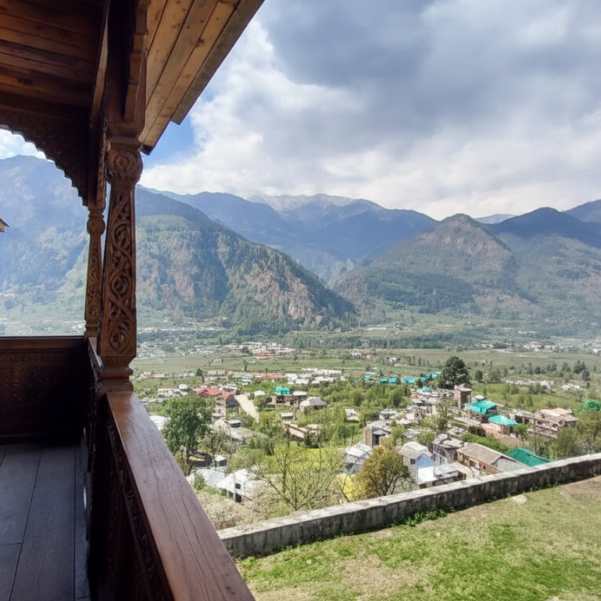
The history after the kingdom is a strange one. When the British took over Kullu from the Sikhs in 1846, Raja Gyan Singh sold the castle to Major Hay, the first assistant commissioner, reportedly in exchange for a rifle. The northern wing was then modified with staircases, fireplaces, and chimneys in a European style, which is why parts of the castle feel oddly British while other sections are purely Himalayan. After the British left in 1947, the building sat idle. HPTDC took it over in 1978 and turned it into a heritage hotel, which it remains today. You can stay here. The rooms are simple, the wifi works, the restaurant serves basic Himachali food, and the view from the upper balcony across the Kullu Valley makes you wonder why Manali, just about 20 km away on the left bank road, gets all the attention.
The castle has two courtyards. One is enclosed by rooms with stone paved floors and carved wooden balconies. The other is open and houses the Jagatipatt Temple, a small stone slab shrine that is said to have been carried here on the back of wild bees, a story the locals tell with a straight face. The inner museum sections have been renovated but the fireplaces, old wooden staircases, and a few pieces of period furniture remain. The museum area is generally open from 9 AM to 5 PM, with a nominal entry fee of ₹30 per person. The restaurant and hotel areas stay accessible later in the evening.
Here is what makes a visit properly worth your time. Naggar Castle by itself is a 30 to 45 minute walk through. Where it becomes a genuinely good half day is when you combine it with the Nicholas Roerich Art Gallery (about 20 minutes on foot uphill from the castle through deodar forest), the Gauri Shankar and Tripura Sundari temples nearby, and the general pace of Naggar town, which is what Manali probably felt like 30 years ago. If you are the kind of traveller who finds Mall Road exhausting, Naggar is the antidote. If you are into Bollywood trivia, the song "Yeh Ishq Haaye" from Jab We Met was shot here.
Quick answers
- Is Naggar Castle worth visiting on a Manali trip?
- Yes, especially if you find Manali crowded and commercial. The castle itself takes 30 to 45 minutes (₹30 entry, museum open generally 9 AM to 5 PM). Combine it with the Nicholas Roerich Art Gallery (20 minute walk from the castle, closed Mondays), the temples nearby, and lunch at the castle restaurant, and you have a genuinely enjoyable half day. The restaurant stays open later than the museum galleries.
- Can you stay at Naggar Castle?
- Yes. HPTDC runs it as a heritage hotel. The rooms are simple and the amenities are basic, but you sleep inside a 560 year old castle with valley views and very few neighbours. It is not luxury. It is quiet, old, and built with Kath Kuni craftsmanship you can see in every wall. Book directly through the HPTDC website or on arrival.
- How far is Naggar Castle from Manali?
- About 20 km via the left bank road along the Beas River, roughly 45 minutes to an hour by taxi. You can also drive south toward Kullu on the highway, turn left at Patlikuhl, and climb about 5 km to Naggar. The drive through the valley is worth doing for the apple orchards and the views.
Quick facts
Everything you need to know at a glance.
At a glance
- What it is
- A 15th century Kath Kuni castle (stone and deodar wood, no mortar), former seat of the Kullu Kingdom, now a heritage hotel run by HPTDC.
- Location
- Naggar town, left bank of the Beas River, Kullu district, Himachal Pradesh. About 20 km from Manali via the left bank road, 26 km from Kullu.
- Altitude
- Roughly 2,040 m / 6,700 ft.
- Built
- Around 1460 AD by Raja Sidh Singh of Kullu. Kath Kuni architecture (stone and deodar wood, no mortar, no nails).
- Visiting hours
- Museum sections generally open 9 AM to 5 PM. Restaurant access extends later. Open daily. Roerich Gallery nearby is closed Mondays.
- Entry fee
- ₹30 per adult, ₹15 for children. Free if staying at the hotel. Fees can change, confirm at the gate.
- Time needed
- 30 to 45 minutes for the castle alone. Half a day if you combine it with the Roerich Art Gallery, temples, and lunch.
On the ground
- Mobile network
- Jio and Airtel work reasonably well in Naggar town. Wifi available at the castle hotel.
- Food
- Castle restaurant serves basic Himachali thalis and chai, open later than the museum. A few small cafes and dhabas in Naggar town.
- Parking
- Small lot near the castle gate. Fills up on weekends and holidays. Park below and walk up if full.
- Washrooms
- Available at the castle.
- Photography
- Allowed in most areas. Some sections may restrict it. Best light on the wooden balconies is early morning and late afternoon. A camera fee may apply.
- Accessibility
- Stone steps and uneven floors. Not fully wheelchair accessible. Seniors with mobility issues should take it slowly.
Seasonal weather
- Apr to Jun25°12°Summer (Apr to Jun)
- Jul to Sep22°14°Monsoon (Jul to Sep)
- Oct to Nov20°5°Autumn (Oct to Nov)
- Dec to Mar12°-2°Winter (Dec to Mar)
Suitable for
- Couples — suitable
- Families — suitable
- Seniors — with some care
- Solo — suitable
- First-timers — suitable
- Pet-friendly — with some care
How to reach Naggar Castle
2 approach routes, with seasonal access.
From Manali
Year round. Snow on the road is rare in winter but drive carefully.- Distance
- About 20 km via the left bank road
- Time
- 45 minutes to 1 hour by taxi
- Road
- Paved road. Left bank road via Jagatsukh, or highway to Patlikuhl then a 5 km climb to Naggar.
- Last fuel
- Fill up in Manali or Kullu. No fuel pump in Naggar.
From Manali, drive south toward Kullu on the main highway. At Patlikuhl (about 15 km from Manali), take the left turn signposted for Naggar. The road climbs for about 5 km through apple orchards and small villages before reaching the castle. You can also take the left bank road from Manali via Jagatsukh, which is the more direct route along the Beas and roughly the same distance. Local HRTC buses run from Manali to Naggar regularly, about an hour each way. A taxi costs roughly ₹800 to ₹1,200 one way, or around ₹1,500 to ₹2,000 for a half day round trip with waiting.
From Kullu
Year round.- Distance
- About 26 km
- Time
- About 1 hour by taxi
- Road
- Highway to Patlikuhl, then a climb to Naggar
- Last fuel
- Kullu has fuel pumps.
From Kullu, drive north on the Manali highway to Patlikuhl and take the right turn for Naggar. Same road as the Manali approach, just from the opposite direction. The Bhuntar Airport (Kullu Manali Airport) is about 32 to 40 km from Naggar, roughly 1.5 hours by taxi.
Best time to visit
Season by season, so you can plan around the weather rather than hope.
- Recommended
Summer
April to June
Clear skies, warm days, apple blossoms. The best window for a visit.
- Temperature
- Roughly 12 to 25°C
- Crowds
- Moderate at the castle, much lighter than Manali
- Road
- Clear and dry
This is the most comfortable window. Days are warm enough for shirtsleeves, nights are cool, and the valley is at its greenest. April and May bring apple blossoms to the orchards around Naggar. June can get warm in the afternoons but the evenings are pleasant. This is also peak tourist season for the Kullu Manali area, so Naggar makes a good escape from the crowds down in Manali.
Monsoon
July to September
Green valley, occasional rain, quieter than summer. Carry an umbrella.
- Temperature
- Roughly 14 to 22°C
- Rain
- Frequent, especially July and August
- Crowds
- Low
Rain is frequent but usually comes in bursts rather than all day. The valley looks its most dramatic in this season, with mist hanging between the hills and the deodar forests looking almost black in the overcast light. Roads to Naggar are generally fine but can be slippery. Fewer tourists, which means you may have the castle to yourself on a weekday morning.
- Recommended
Autumn
October to November
Clear air, sharp light, apple harvest. Many say this is the best time.
- Temperature
- Roughly 5 to 20°C
- Crowds
- Moderate during Dussehra, otherwise low
- Photography
- Best light of the year
After the monsoon clears in late September, the air gets crisp and the mountains are at their sharpest. October is apple season in Naggar, and the orchards are heavy with fruit. The castle looks particularly striking against the autumn sky. The Kullu Dussehra festival (usually in October) brings energy to the region if your dates overlap. Evenings get cold by November.
Winter
December to March
Cold, quiet, occasional snow. The castle has a different charm under grey skies.
- Temperature
- Roughly minus 2 to 12°C
- Snow
- Possible, especially Jan and Feb
- Crowds
- Very low
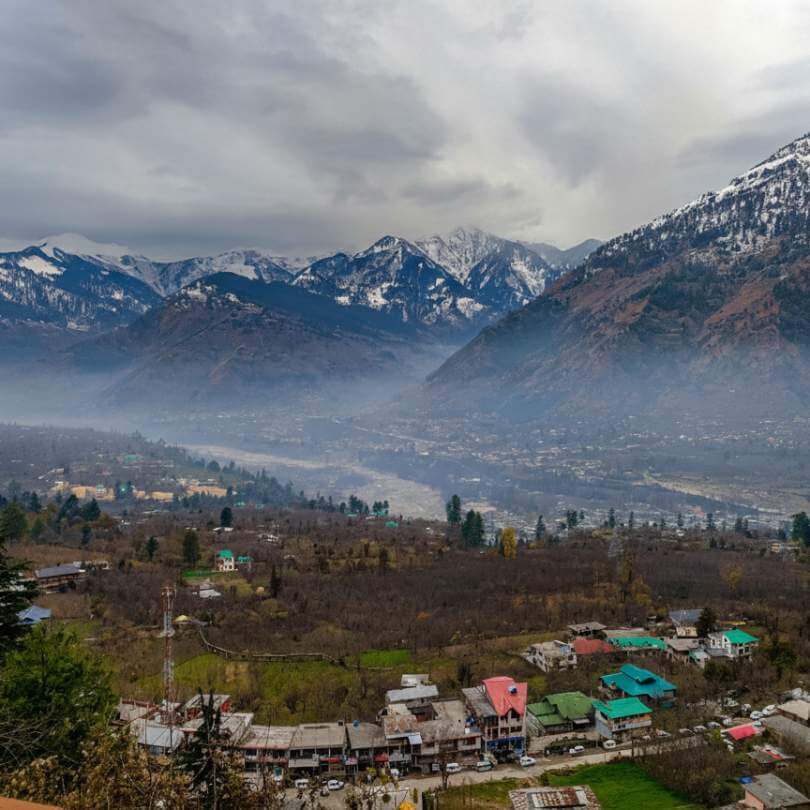
Naggar gets cold in winter, with temperatures dipping below zero at night. Snowfall is possible, especially in January and February, and when it happens, the castle looks like something out of a period film. The town is very quiet. The castle hotel remains open, but some nearby attractions may reduce their hours. Carry serious warm clothing. The drive from Manali is fine in normal conditions but can be tricky after heavy snow.
Things to see & do
4 things worth your time at Naggar Castle.
Walk through the castle
30 to 45 minutesStart from the main gate and walk through both courtyards. Look up at the Kath Kuni walls, alternating layers of stone and deodar wood that have held together for over 500 years without mortar or nails. The carved wooden balconies on the upper floor catch the best light in the morning and late afternoon; if you are photographing the woodwork, that is when to go. The Jagatipatt Temple in the open courtyard is small but has an interesting local legend. Inside, the fireplaces and wooden staircases from the British modification mix with the Himalayan stonework. Take your time on the upper balcony. The valley view from here is the reason the Kullu kings picked this spot. The inner museum sections are generally open 9 AM to 5 PM, entry ₹30 per person. Photography is allowed in most areas, but some sections may have restrictions. Confirm at the gate.
Visit the Nicholas Roerich Art Gallery
1 to 1.5 hours including the walkAbout a 20 minute walk uphill from the castle through deodar forest, or a short drive. The gallery is housed in the former residence of Nicholas Roerich, a Russian artist who settled in Naggar in the late 1920s and lived here until his death in 1947. The ground floor displays his original paintings of Himalayan landscapes, Lahaul, and Ladakh, rendered in vivid colour. The upper floor preserves his personal rooms, visible through glass windows. His 1930s Dodge car sits in the garden. A small entry fee applies. The gallery is generally closed on Mondays. Even if art is not your thing, the walk through the forest to get there and the views from the estate make it worth the effort.
Lunch at the castle restaurant
45 minutes to 1 hourThe HPTDC restaurant inside the castle serves a basic Himachali thali, dal, rice, roti, and a vegetable or two. The food is honest and filling, not fancy. The setting is what you are paying for. Eating inside a medieval castle with valley views is not something you get to do often. Prices are reasonable. The restaurant stays open later than the museum sections, so you can visit for a late lunch or evening chai even after the inner galleries close.
Explore Naggar town on foot
1 to 2 hoursWalk downhill from the castle through the narrow lanes of Naggar. Visit the Gauri Shankar Temple (dedicated to Shiva, with some fine stone carvings dating back centuries) and the Tripura Sundari Temple a short walk away. The town is small, unhurried, and lined with traditional Himachali houses. Apple orchards surround the area, and in season (September to November), you can buy fruit directly from the growers. This is what the Kullu Valley felt like before the hotels arrived.
Know before you visit Naggar Castle
The practical bits, from people who have been.
What Naggar Castle actually isA 15th century royal castle turned heritage hotel. ₹30 entry, museum open 9 AM to 5 PM. Worth 30 to 45 minutes, longer if you combine it with the area.
Naggar Castle is a medieval stone and timber castle built around 1460 AD by Raja Sidh Singh of Kullu. It was the seat of the Kullu Kingdom for centuries before the capital moved downstream to Kullu town. The building is constructed in the Kath Kuni technique: layers of stone and deodar wood alternated without mortar or nails, which makes the structure both earthquake resistant and visually distinctive. The doors are carved from single pieces of deodar. No iron was used in the original construction. The castle survived the 1905 Kangra earthquake when many newer buildings in the region did not.
After the kingdom ended, the castle was sold to a British officer (reportedly for a rifle), used as a courthouse, and eventually taken over by HPTDC in 1978. Today it operates as a heritage hotel. You can visit as a day tripper (₹30 entry for the museum sections, open generally 9 AM to 5 PM) or stay overnight. The castle has two courtyards, carved wooden balconies, old fireplaces from the British period, and the small Jagatipatt Temple in the open courtyard.
Honestly, the castle is compact. If you are expecting something on the scale of a Rajasthani fort, recalibrate. Its strength is atmosphere, not size. The Kath Kuni walls, the valley views from the upper balcony, and the sense that you are standing inside something genuinely old and still standing because it was built properly. That is the draw.
Who should visitGreat for couples, history lovers, and anyone wanting a break from Manali's crowds. Families and seniors can manage easily.
Naggar Castle works well for almost everyone. Couples enjoy the quiet, historical atmosphere. Families with children can visit comfortably in under an hour, and the walk around Naggar town adds variety. Seniors can manage the castle itself, though it involves some stone steps and uneven surfaces that require care. The Roerich Art Gallery is a 20 minute uphill walk, which may be difficult for anyone with knee or mobility issues (you can also drive there).
If you are someone who finds Manali's Mall Road overwhelming, Naggar is a welcome change of pace. It is not a full day destination on its own, but combined with the Roerich Gallery, the temples, and a meal at the castle, it fills a relaxed half day nicely. If you have zero interest in heritage or architecture and want adventure activities, skip this and head to Solang Valley instead.
How to plan your visitHalf day trip from Manali. Museum 9 AM to 5 PM. Combine with the Roerich Gallery and Naggar's temples.
The standard plan. Leave Manali after breakfast, take a taxi or local bus to Naggar (about an hour via the left bank road). Visit the castle (30 to 45 minutes), walk up to the Nicholas Roerich Art Gallery (20 minutes walk, 1 hour at the gallery, closed Mondays), come back down, have lunch at the castle restaurant, explore the temples, and return to Manali by mid afternoon.
If you want to stay at the castle, book directly with HPTDC. The rooms are not fancy but the experience of sleeping inside a 560 year old castle, waking up to the valley, and having the place to yourself after the day visitors leave is genuinely worth it. Mornings and evenings are the best times at the castle. The light on the wooden balconies is softest before 10 AM and after 4 PM, which is also when the tourist buses have not arrived or have already left.
The inner museum sections are generally open 9 AM to 5 PM. The restaurant stays open later, so you can come for an evening chai even after the galleries close.
Small practical thingsCarry cash (₹30 entry, no ATM in Naggar). Wear sturdy shoes. Parking limited at the gate. Best photo light: early morning and late afternoon.
Carry cash. The castle charges ₹30 entry, and the local shops and cafes in Naggar are not always set up for UPI or card payments.
Wear shoes with grip. The castle has stone steps and uneven floors that can be slippery, especially after rain. The walk to the Roerich Gallery is uphill on a paved but steep road.
There is no ATM in Naggar. The nearest ones are in Patlikuhl or Manali.
Parking near the castle gate is limited. A small lot sits just below the entrance, but it fills up on weekends and holidays. If it is full, you may need to park a little further down and walk up.
The best light for photographing the carved wooden balconies and the Kath Kuni walls is early morning or late afternoon, when the sun comes in low and side lights the woodwork.
No drone flying is advisable without checking local rules.
The castle hotel has basic wifi and 24 hour power backup. If you are staying, bring your own entertainment for the evening. Naggar does not have nightlife. That is the point.
Nearby attractions
Other places worth the detour.
Nicholas Roerich Art Gallery
About 1.5 km uphill from the castle (20 minute walk)
The former home of Russian artist Nicholas Roerich, now an art gallery displaying his original Himalayan paintings. A 20 minute walk through deodar forest from the castle. Generally closed on Mondays. Small entry fee. Worth visiting even if art is not your thing, for the walk and the views from the estate.
Gauri Shankar Temple
About 200 m from the castle
An ancient Shiva temple near the castle with fine stone carvings in the traditional Himachali style. A quick stop on your walk through Naggar town.
Tripura Sundari Temple
About 1 km from the castle
A small but architecturally interesting temple dedicated to the goddess Tripura Sundari. The pagoda style structure is one of the more distinctive temples in the Kullu Valley. Nicholas Roerich painted it, and you can compare his interpretation at the gallery.
Jana Waterfall
About 12 km from Naggar
A small waterfall in a forested area, reachable by a short drive and a moderate walk. Worth combining with Naggar if you have a full day and enjoy short hikes.
Hadimba Temple
About 20 km from Naggar (in Manali)
The famous 16th century wooden temple in Manali's deodar forest. Most visitors see it separately as part of a Manali day, but if you are driving between Naggar and Manali, it is on the way.
Common questions about Naggar Castle
How much time do you need at Naggar Castle?
The castle itself takes 30 to 45 minutes to walk through. If you combine it with the Nicholas Roerich Art Gallery (20 minute walk, plus an hour at the gallery), the nearby temples, and a meal, plan for a relaxed half day.
What is the entry fee for Naggar Castle?
₹30 per person for adults, ₹15 for children. If you are staying at the castle hotel, entry is typically free. Fees can change, so confirm at the gate.
What are the timings for Naggar Castle?
The inner museum sections are generally open from 9 AM to 5 PM, every day. The restaurant and hotel areas stay accessible later in the evening. The nearby Roerich Art Gallery is generally closed on Mondays and national holidays. Timings can shift by season, so confirm locally before visiting, especially in winter.
Can you stay at Naggar Castle?
Yes. HPTDC operates it as a heritage hotel. The rooms are basic but clean, with modern amenities including wifi, power backup, and an in house restaurant. Book directly through the HPTDC website. Staying means you get the castle to yourself in the mornings and evenings, when the day visitors have not arrived or have already left. That is the best part.
How do I get to Naggar Castle from Manali?
About 20 km via the left bank road along the Beas. A taxi takes 45 minutes to an hour and costs roughly ₹800 to ₹1,200 one way. You can also take an HRTC bus from Manali. If driving, head south toward Kullu on the highway, turn left at Patlikuhl, and climb about 5 km to Naggar.
Is Naggar Castle worth visiting?
Yes, especially if you appreciate old architecture, history, and a quieter alternative to Manali. It is not a large fort and you will not need more than an hour inside. But the Kath Kuni construction (stone and deodar wood without mortar, built c. 1460 AD by Raja Sidh Singh), the valley views from the upper balcony, and the atmosphere of Naggar town make it a genuinely pleasant half day trip. Combine it with the Roerich Art Gallery for a more complete experience.
What is Kath Kuni architecture?
A traditional Himachali building technique that alternates layers of stone and deodar wood without using mortar or nails. The interlocking layers give the structure both flexibility and earthquake resistance. Naggar Castle, built around 1460 AD, is one of the best surviving examples. It survived the 1905 Kangra earthquake, which destroyed many newer buildings around it.
Is Naggar Castle the same as the Roerich Art Gallery?
No. They are two separate places, about 1.5 km apart. The castle is a medieval fort turned hotel. The Roerich Gallery is the former residence of the Russian artist Nicholas Roerich, now a museum of his paintings. Most visitors combine both in a single trip.
Is there food available at Naggar Castle?
Yes. The HPTDC restaurant inside the castle serves basic meals, Himachali thalis, and chai. A few small cafes and shops in Naggar town also offer food. The restaurant stays open later than the museum sections. Simple, filling, and reasonably priced.
Is Naggar Castle good for families with children?
Yes. The castle is easy to explore with children. The walk through Naggar town is gentle. The Roerich Gallery walk is uphill and may tire very small children, but you can also drive there. The town is safe and quiet.
Related guides
Posts about Manali
- Medical Help in Manali for Tourists 2026: Hospitals, Pharmacies and Emergency Steps
- Vegetarian and Jain Food in Manali 2026: Where to Eat Without Guesswork
- Mobile Network, Internet, UPI and ATMs in Manali 2026: What Works Where
- Shimla to Manali in 2026: Distance, Travel Time, Bus vs Cab and the Best Transfer Plan
- Manali with Pets in 2026: Road Travel, Pet-Friendly Stays, Snow Safety and Practical Rules
- Is Manali Safe for Solo Female Travellers in 2026? Areas, Transport and Winter Safety